work packages
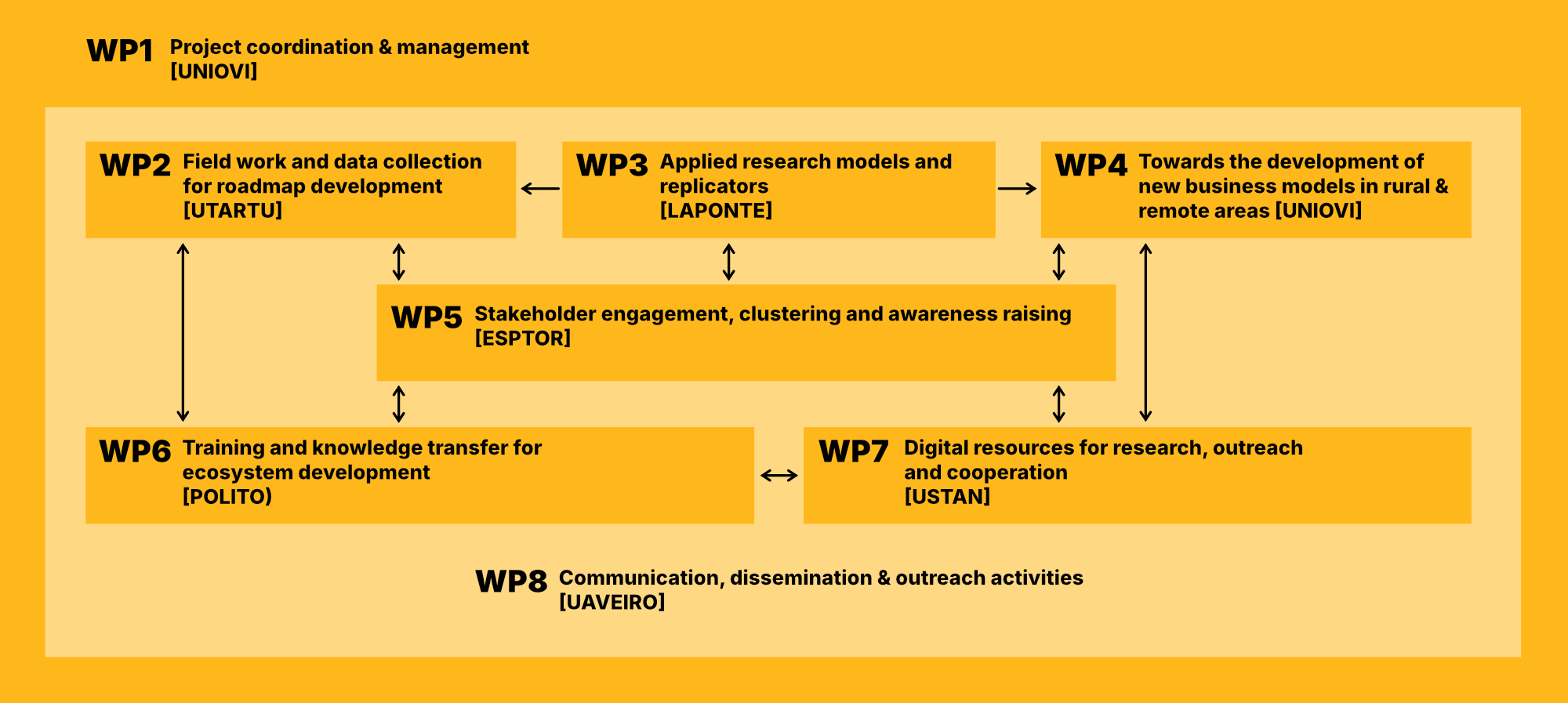
CULTURALITY is organised into eight work packages across its 48-month duration, spanning coordination and management through to basic, applied and experimental research, digital resource development, and communication and dissemination of results. This structured organisation ensures the project’s success, guaranteeing a coherent progression across the different phases of work and effective articulation between the consortium partners.
WP1
Project coordination & management
Lead: UNIOVI / Start Month : 1 / End Month: 48
Objectives:
- Establish, promote and maintain a smooth communication between partners and with the EC, so all the generated knowledge is managed and disseminated in a coherent manner. Likewise, periodic meetings will be held with all the partners, the coordinators of the work teams; as well as the KoM.
- Overall coordination of the project to comply with the Grant Agreement by ensuring the effective realisation of the project objectives and goals as well as the completion of milestones and a timely production of high-quality deliverables.
- Perform all the management activities according to high quality standards, including financial and legal aspects, administrative issues and reporting tasks.
- Monitor and report project progress, achievements and risks against goals and KPIs.
- Ensure throughout the duration of the entire project equity and respect both among the members themselves, the agents involved, and also while communicating the results obtained.
WP2
Field work and data collection for roadmap development
Lead: UTARTU / Start Month : 4 / End Month: 36
Objectives:
- Research of tangible and intangible aspects of rural crafting within project regions for mapping a craft inventory. It will include the documentation of the productive processes with graphic and audiovisual documentation and the relevancy and the role that the crafts and intangible heritage play within local communities.
- Digitise and document crafts related to oral traditions into the Rural Oral Tradition Archive as a preservation
method for a highly threatened intangible heritage asset. By creating an inventory of archives related to sound or audio-visual recordings of oral knowledge, the conservation of a great part of what became one of the most vulnerable types of heritage because of the abandonment of rural areas will be guaranteed. An analysis of the quality and relevancy will be carried out, organizing all the materials from various sources and supports, selecting the most relevant ones. - Scope women’s historic role in development and guardianship of popular artisanal crafts, drawing relations and
differences between regional areas. The historical role of women as creators, bearers and transmitters of traditional cultures and values will be studied and analysed in order to highlight it as an essential aspect in its conservation. - Analysis of links of traditional rural crafting to modern rural crafting inspired by traditions, manifestations, recording change and similarities within the associated contexts of cultural landscapes. An in-depth study of the connections between traditional creation and modern artistic processes will be carried out, analysing not
only the inspirations, but also the influences on the technique.
WP3
Applied research models and replicators
Lead: LAPONTE / Start Month : 4 / End Month: 45
Objectives:
- Inventory and study of the experiences already carried out of good practices in initiatives of the rural environment in Europe (those that have worked successfully for local communities, that have had continuity, creative tourism and/or the economic return of remote areas). In this section, the interaction of the public in social networks (data mining and sentiment analysis) will be analyzed.
- Joint and comparative analysis of the results of the RuralSpots (WP5), classification and typology, with special attention to the potential link between crafts and immaterial knowledge, and new creative practices.
- Determine, from an interdisciplinary and multimodal perspective, which RuralSpots, in addition to the good practices analyzed in previous events, are eligible for becoming LivingLab.
- Joint analysis of the RuralEvents (WP5), as models of good practices that function as a framework for creative activities that are compatible and respectful of local traditional practices, but capable of promoting sustainable tourism modalities, aimed at new audiences and that favor the non-seasonal employability.
- Creation of tools (RuralToolBox and Handbook of good practices). Create a toolbox, considering the information obtained through the organization of the RuralSpots and RuralEvents as well as through the data mining and the contingence analysis. This toolbox will allow us to develop new business models of sustainable creative tourism.
- International Networking. Promote the implementation of Replicators, both with project partners and with those local communities from other places that may be interested, both European and non-EU (see list of supports).
WP4
Towards the development of new business models in rural & remote areas
Lead: UNIOVI / Start Month : 4 / End Month: 45
Objectives:
- Analyse local development strategies in terms of attractiveness of a rural territory, interacting with local actors to understand the territories with more/less capacity to attract tourists and assess the primary factors determining the attractiveness or appeal of the rural territories.
- Grasp the territorial marketing regarding the valorisation of cultural landscapes, especially using the synergies of RuralSpots and the dialogue with local communities.
- The information collected in the previous two points will be used to run a SWOT analysis for each of the regions represented in the project.
- Application of artificial intelligence methods to the analysis of personal feelings regarding cultural material and immaterial heritage. Collect qualitative information relative to the personal appraisal and perception of material and immaterial heritage. The aim is to convert it into a statistical distribution of sentiments and emotions. Moreover, using the analysis of the opinions, comments, and ratings about the CULTURALITY activities in the social networks could be used to write a deliverable that could of interest for the EU.
- Using cluster analysis, factorial analysis, and qualitative regression analysis to define different profiles of cultural tourists, through the statistical estimation of the links between the reported feelings and impressions, and the different elements of cultural heritage, as well as the geographical features of the site where the activity takes place. This typology will enhance the capacity to design rural tourism promotion plans and to target them to the population segment on which they will have the greatest impact.
- Use contingent valuation of rural products to estimate the economic value of the different elements of the cultural
material and immaterial heritage.
WP5
Stakeholder engagement, clustering and awareness raising
Lead: ESPTOR / Start Month : 7 / End Month: 42
Objectives:
- Create a Stakeholder Database including all relevant actors to promote collaboration and reinforcement in the project ecosystem and related value chains (museums, tourist agents, associations, businesses, local communities…).
- Pro-active engagement of relevant stakeholders to promote symbiosis, synergies and exchange of newfound knowledge and innovation through the organisation of suitable clustering activities for cross-fertilisation of ideas and peer-to-peer learning.
- Involvement of local communities to increase awareness on the development of new business models for sustainable cultural tourism as a powerful tool to boost economic and social revitalisation strategies for rural and remote areas and boost the acceptance of the project outputs.
- Promotion of knowledge exchange and peer-to-peer learning through the design and implementation of #RuralSpots as a strategic concept for rural development.
- Organize #RuralEvents as different activities aimed at the general public for rural development based on cultural
and creative tourism, taking into account all sectors of the population, including those generally unrelated to cultural products. (We include festivals, markets, expositions, etc.). The synergies of the RuralSpots and the LivingLabs will be taken into account.
WP6
Training and knowledge transfer for ecosystem development
Lead: POLITO / Start Month : 4 / End Month: 45
Objectives:
- Construction of a research background which will help to identify learning models and innovative pedagogies focused on “training and knowledge transfer for ecosystem development” to be implemented. The intent is to help deepen the connection between academic research, cultural institutions and reference communities, but also for decision-makers in the political and business world. These processes are aimed at: the formation of skills; the dissemination of knowledge; and the experimentation of pedagogies.
- Creation of a handbook based on the previous point containing guidelines and good practices scalable in different contexts. Also, it will include toolkits for understanding and communicating the cultural implications of the craft specificities in the different territories; tools capable of facilitating processes of skills-transfer between different territories and codifying new ways of interpreting tradition through the development of design skills at different scales, from artefacts to services, to strategies.
- Implementing a set of actions that will be inspired by the Design Thinking approach: “Empathise, Define, Ideate,
Prototype, Test”. DTA allows us to operate in a systematic way andto integrate material scales (physical territories
and production processes), immaterial scales (cultural territories and traditions) and possible new outcomes (new craft, making…). - Experimentation of learning models with problem solving approaches (Project Based Learning and trial and error)
involving the stakeholders (WP5), structuring their mutual relationships (for example Gephi Model) and tracking their mutual learning experience, also starting from the data collected after the first phases (WP2-4-5). - Planning and organisation of educational events at different and coordinated levels: academic, local, targeted
communities.
WP7
Digital resources for research, outreach and cooperation
Lead: USTAN / Start Month : 4 / End Month: 48
Objectives:
- Digitise tangible and intangible heritage practices for preserve, disseminate and facilitate future studies.
- Develop a virtual museum (VERAP – Virtual European Rural Artisans Platform framework and archive to a) showcase and connect crafters through mapping of tangible and intangible heritage in unique cultural landscapes; b) Integrate a bespoke E-commerce platform to facilitate craft trading and publicity, offering a pathway for rural crafters to maintain a livelihood from culturally significant artistry and c) Help to solve another of the problems of remote areas, accessibility and transport, especially for people with reduced mobility.
- Advance transmedia storytelling through a framework for co-operative participation of artisans and their communities, using emergent immersive VR, AR, mobile technologies and conventional film making.
- Visualisation of climate change impact and related threats to rural crafting within cultural landscapes which jeopardise heritage futures, to contribute to an emotive understanding and engagement from audiences for action
and advocacy
WP8
Communication, dissemination & outreach
Lead: UAVEIRO / Start Month : 4 / End Month: 48
Objectives:
- Ensure an effective awareness campaign on sustainable cultural tourism in rural & remote areas and ensure the project’s scientific dissemination, broad communication, outreach activities, and democratisation through several and diverse channels and initiatives. Design a visual identity and branding to be used in all dissemination & outreach activities related to the project.
- Design a suitable project website as a graphic mirror of the project’s profile and continuous development.
- Design and implement a tailored plan of diffusion activities to promote the project and its results to targeted stakeholders.
- Launch an International Photographic Competition within the project’s core that will result in different exhibitions to promote the dissemination.